
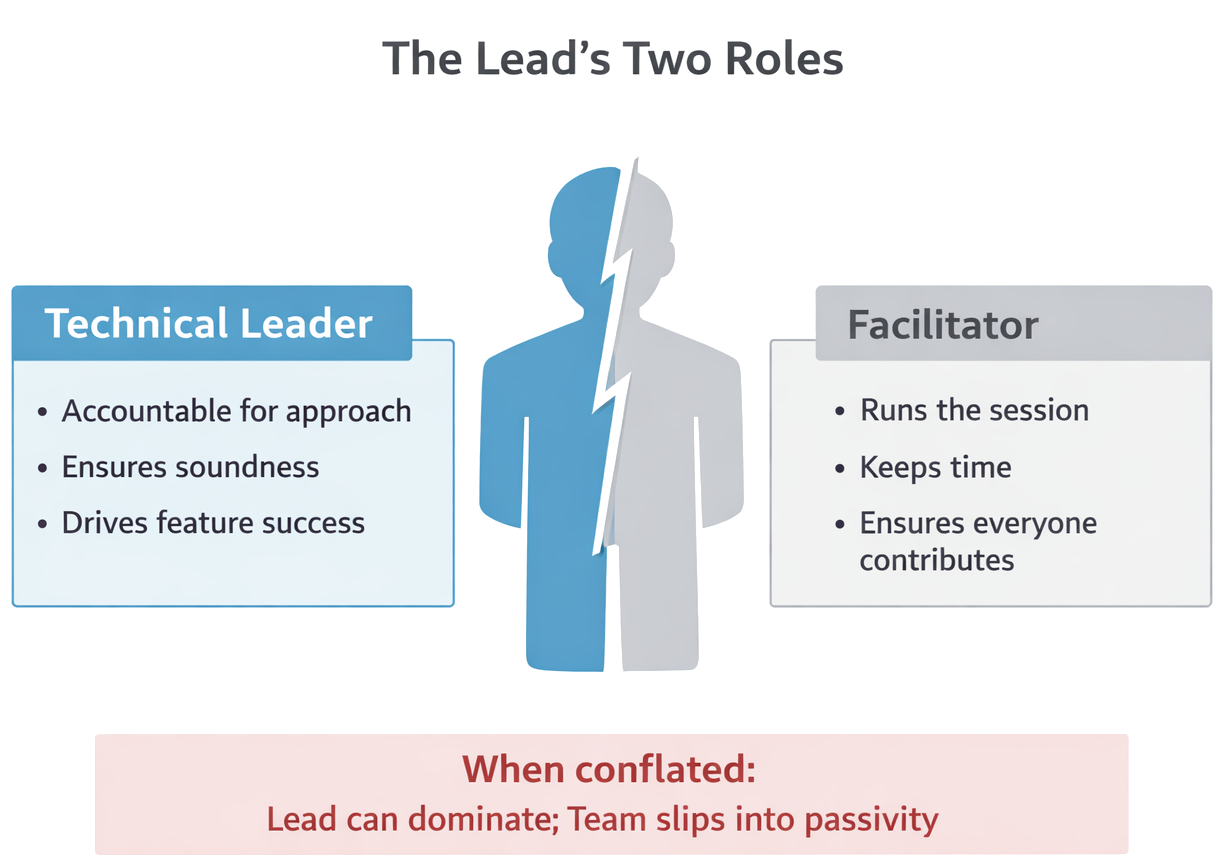
The lead engineer in tech refinement carries two roles at once: technical leader ; the person accountable for the soundness of the approach and the success of the feature, and meeting facilitator ; the person who runs the session, keeps time, and ensures everyone can contribute. When those roles are conflated, the lead can dominate the conversation without realizing it, and the team can slip into passivity. This chapter explores the tension between the two roles, how to "share the lead" without losing oversight, and how to recognize and manage your own cognitive load.
Technical leader vs. meeting facilitator: the tension
The technical leader is responsible for the quality of the technical outcome. They care that the approach is sound, that risks are identified, and that the team does not commit to something dangerous or unsustainable. They have the experience and the authority to steer the discussion and to make the final call when needed. The facilitator is responsible for the process: that the meeting has a clear scope, that everyone has a chance to speak, that the discussion stays on track, and that the output is captured. They hold the space; they do not necessarily fill it with their own ideas.
When the same person does both, tension is inevitable. The lead wants to contribute their technical view, and they should, but if they are also facilitating, they may speak first, speak most, or unconsciously steer the conversation toward their preferred solution. The rest of the team may defer to them or wait for them to "give the answer." The lead may not notice, because from their perspective they are simply doing their job: leading technically and running the meeting. From the outside, the meeting can look like a lead monologue with occasional input from others.
Separating the roles completely (e.g., rotating facilitation) is one option. Another is to keep both roles but to constrain how the lead uses their technical voice: they facilitate, but they deliberately hold back from being the first or the loudest voice on technical content. They create space for others to propose and to debate, and they step in as a guide or a guardrail when needed. That shift is the essence of "share the lead."
When the lead dominates the conversation (and doesn't notice)
Because the lead is the one facilitating and sharing the screen, they are often the first to speak when a new ticket is opened. They read the ticket, they may already have a mental model of the solution, and they naturally start explaining or proposing. The rest of the team listens. By the time the lead asks "What do you think?", the direction may already feel set, and the team may be reluctant to contradict or to propose something different. The lead may believe they are inviting input; from the team's perspective, the invitation can feel like "agree with me."
In the teams I have observed, it was often the engineer with the most experience in the relevant area ; or the one most comfortable with the technology ; who took the lead and presented the technical solution, even when they were not necessarily the one who would implement it. The more junior profiles were mainly in observation mode, occasionally asking questions or making remarks. The rest of the team was more in a supporter role than a contributor role. The lead may not notice this dynamic; they are focused on the content and on moving the discussion forward. Without feedback or a deliberate change in behavior, the pattern can persist.
From the field. In one retrospective, a junior engineer admitted they often had a different idea during refinement, but by the time the lead had walked through their reasoning, it no longer felt worth bringing up. The issue was not authority in itself ; it was timing. Once a complete solution had been laid out clearly and confidently, proposing an alternative felt like interrupting a conclusion rather than contributing to an open discussion. The lead had not noticed the pattern. They were not trying to dominate the conversation ; they simply tended to think aloud early, filling the silence before others stepped in. After that retro, they changed one habit: before sharing their own view, they started asking, Who wants to take a first crack at the approach? Sometimes the room still stayed quiet. Sometimes someone offered only a partial thought. But over a few refinements, more alternatives surfaced before the lead spoke, and discussions became noticeably less one-directional.
"Share the lead": empowering the team without losing oversight
"Share the lead" means that the lead engineer does not have to be the one who introduces the technical solution. They can take a more reserved role: a junior (or any other team member) presents the business need and proposes a first technical approach. Others add ideas. The team discusses and narrows down the options based on context ; ideally without the lead having to intervene too early. The lead is in active listening mode: they check that the team has considered the necessary context, they share experience and advice when it adds value, and they step in as guardrails when the chosen solution could create a dangerous situation.
The guardrails role is critical. The lead ensures that the solution does not ignore security, underestimate or overestimate complexity or scalability, disregard long-term maintenance, or ignore budget or time constraints. They also watch for personal biases or groupthink. They do not need to approve every detail; they need to catch the cases where the team is about to make a choice that would cause serious harm. With that safety net, the team can propose and debate more freely; the lead intervenes only when necessary.
The result is a shift from "the lead decides" to "the team decides, with the lead as guide and guardrail." The lead remains accountable for the technical success of the feature, but they exercise that accountability by enabling good decisions rather than by making all of them alone.
The lead as coach, not just decision-maker
The expected outcomes of tech refinement are usually framed as: agree on the technical approach and ensure alignment between tech and product. Those are the primary goals, and they matter. But the lead has an additional opportunity: to use refinement as a moment to coach the team. To help less experienced engineers practice thinking through problems, to expose the reasoning behind technical choices, and to build the team's autonomy so that over time they need the lead less for every decision.
Recognizing and managing your own cognitive load
The lead carries a heavy cognitive load during refinement: they facilitate, they share the screen, they take notes or create sub-tasks, they contribute technically, and they try to notice who is engaged and who is not. It is very difficult to do all of that well at once. When the load is too high, something gives ; often the lead's ability to notice the quiet engineer, to invite the dissenting view, or to step back and let others drive.
Recognizing that load is the first step. The second is to reduce it by distributing tasks (as in Chapter 5): someone else shares the screen, someone else captures the sub-tasks, someone else recalls the business context. The lead can then focus on facilitation and technical leadership, and on reading the room. The third is to accept that the lead cannot do everything. On days when the backlog is dense or the tickets are complex, it may be enough to get through the agenda and to capture the outcomes; the coaching and the "share the lead" ideal may take a back seat. The goal is to make the default a sustainable one, so that the lead has the bandwidth to lead and to coach, not only to execute the mechanics of the meeting.
From the field. A lead engineer noticed they were often exhausted after refinement and could not recall what two of their teammates had said during the session. They had been juggling too much ; sharing the screen, typing, steering the discussion, and realized they were missing what was going on in the room. Distributing those tasks (as in Chapter 5) freed them to notice and to include.
Checklist (this chapter)
- Facilitation and technical leadership not conflated: lead does not propose the solution first on every ticket.
- Tasks distributed (screen, notes, context) so the lead can read the room and invite quiet participants.
- Lead acts as guardrail (risks, constraints) and coach, not as the only decision-maker.
Key takeaways
- The lead holds two roles: technical leader (soundness of the approach) and facilitator (process, time, inclusion). Conflating them leads to the lead dominating without noticing.
- "Share the lead": don't be the first or loudest voice. Invite someone else to propose the approach first; step in as guardrail (risks, constraints) and coach, not as the only decision-maker.
- Reduce cognitive load by distributing tasks (screen, notes, context); that frees the lead to read the room and include quiet or passive participants.
The passages above are excerpted from Chapter 20: The Lead Engineer's Dual Role in Refining Engineering: How Teams Think Before They Build.
Go deeper
The book covers facilitation patterns, team anti-patterns, and practical checklists to make refinement sessions more reliable.
Read free chapters